Building AI features is easy. Finding a problem worth solving is the hard part. I spend more time interrogating the problem than designing the fix. That habit became two checklists. INBA tests the problem. VENBA tests the solution. Both names come from Tamil. Inbam carries the sense of joy. The venba is the metre of the Thirukural.
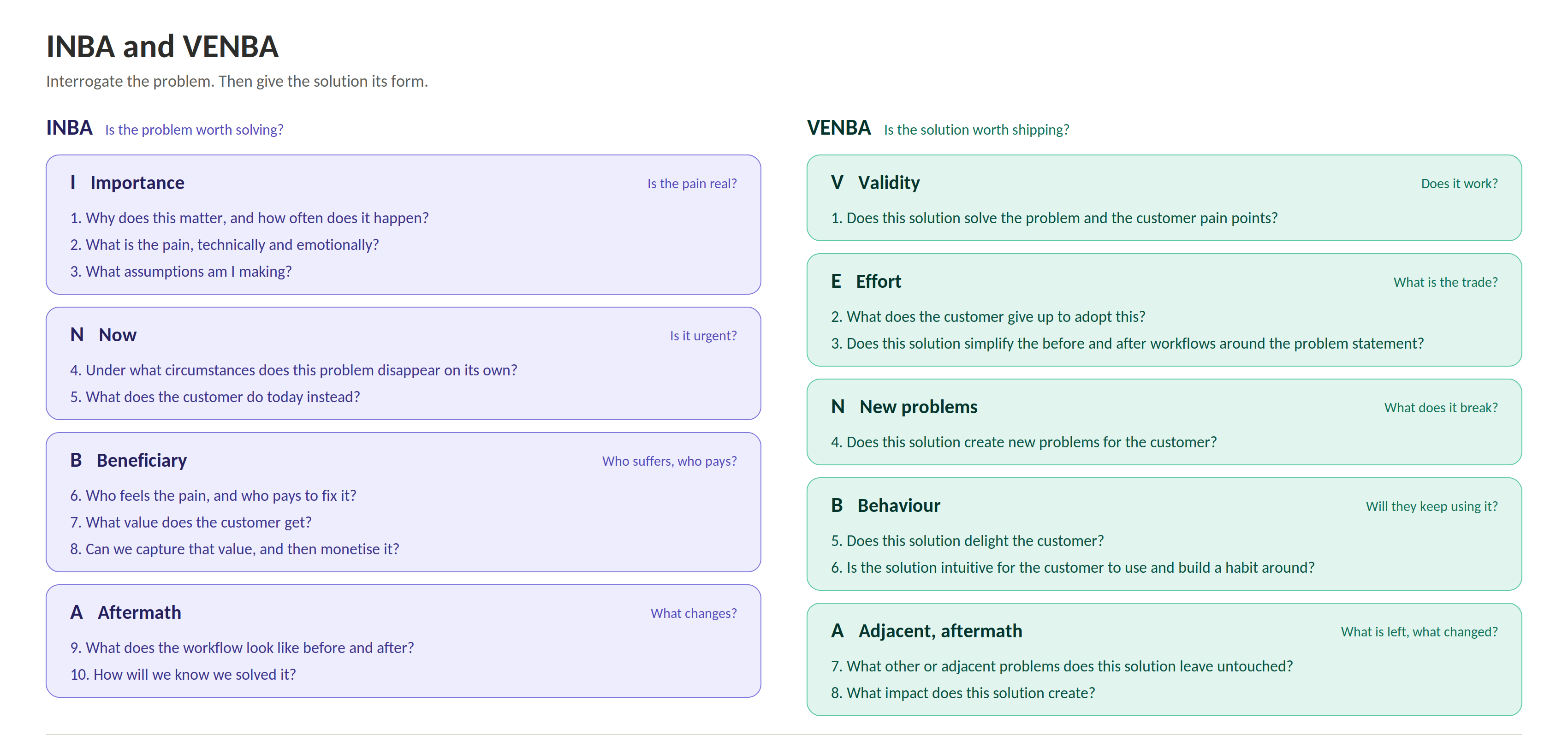
INBA: is the problem worth solving
INBA holds ten questions in four buckets. Importance asks whether the pain is real today. Now asks whether it is still real next quarter. A problem that fades on its own never needed a roadmap slot.
I. Importance
- Why does this matter, and how often does it happen?
- What is the pain, technically and emotionally?
- What assumptions am I making?
N. Now
- Under what circumstances does this problem disappear on its own?
- What does the customer do today instead?
Beneficiary separates the person who feels the pain from the person who signs the invoice. They are rarely the same, and the gap between them kills more features than weak engineering. Aftermath forces a measurable change before anyone writes code.
B. Beneficiary
- Who feels the pain, and who pays to fix it?
- What value does the customer get?
- Can we capture that value, and then monetise it?
A. Aftermath
- What does the workflow look like before and after?
- How will we know we solved it?
VENBA: is the solution worth shipping
A kural venba runs two lines and seven feet, and the metre is unforgiving. A thought that breaks the rules is not a venba. Features work the same way. Validity is the pass or fail gate. Effort is the ledger: what the customer gives up, and what they get back.
V. Validity
- Does this solution solve the problem and the customer pain points?
E. Effort
- What does the customer give up to adopt this?
- Does this solution simplify the before and after workflows around the problem statement?
New problems is the honesty check. Behaviour asks whether people return on day 50, not on day one. Adjacent and aftermath sets the boundary and the score.
N. New problems
- Does this solution create new problems for the customer?
B. Behaviour
- Does this solution delight the customer?
- Is the solution intuitive for the customer to use and build a habit around?
A. Adjacent and aftermath
- What other or adjacent problems does this solution leave untouched?
- What impact does this solution create?
Final thoughts
Neither list guarantees a good product. They surface expensive mistakes early, when a mistake costs a conversation rather than a quarter. Run INBA before you sketch anything. Run VENBA before you commit. When a question makes you uncomfortable, answer that one first.